Nucleation
The recording reports mean q6-bar on the 148-frame mW trajectory. The first of those frames has q6-bar 0.26063, the value printed below.
The full file is figshare
10.6084/m9.figshare.11448702.v1.
input/traj/nucleation_three.lammpstrj is its first three frames,
timesteps 15677000, 15678000, and 15679000. Each frame has 4096
molecules of type 1.
Labels
Crystal labels are cubic, hexagonal, reCubic, and reHex. These three frames print cubic and hexagonal only.
seams chill-plus input/traj/nucleation_three.lammpstrj --type 1 --cutoff 3.5 --frame 1 --last 3
nop 4096 clathrate 20 cubic 47 hexagonal 62 interClathrate 138 interfacial 240 water 3589
nop 4096 clathrate 16 cubic 50 hexagonal 60 interClathrate 145 interfacial 227 water 3598
nop 4096 clathrate 16 cubic 44 hexagonal 69 interClathrate 147 interfacial 228 water 3592
The lines are frames 1, 2, and 3, in that order.
Mean q6-bar
seams steinhardt input/traj/nucleation_three.lammpstrj --type 1 --cutoff 3.5 --l 6 --frame 1 --last 3
nop 4096 q6 0.493523 q6bar 0.26063
nop 4096 q6 0.493773 q6bar 0.260923
nop 4096 q6 0.495485 q6bar 0.261047
q6-bar is one number per molecule. On the first frame it does not separate the 47 cubic molecules from the 62 hexagonal ones. The CHILL+ line above does.
Largest crystal cluster
Two crystal molecules share a cluster when the 3.5 Å cutoff list joins them. The largest cluster is smaller than the cubic-plus-hexagonal count. The other crystal molecules sit in other components.
frame |
cubic |
hexagonal |
largest cluster |
|---|---|---|---|
1 |
47 |
62 |
59 |
2 |
50 |
60 |
64 |
3 |
44 |
69 |
70 |
On the first frame the cubic and hexagonal counts sum to 109, and the largest component holds 59 of them.
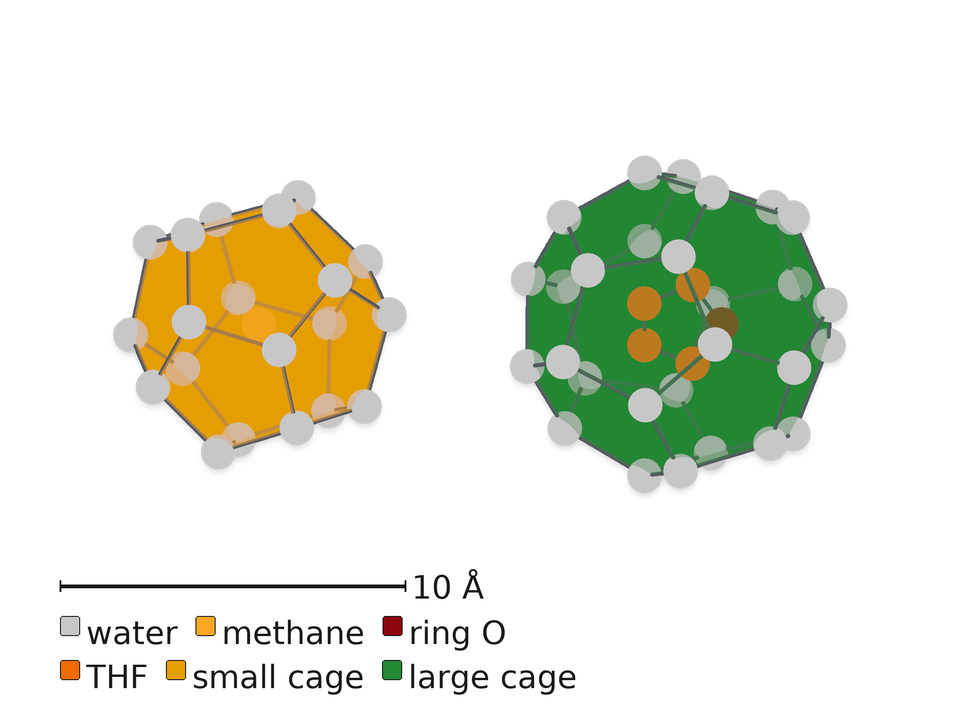
First nucleation frame, colored by published CHILL+.