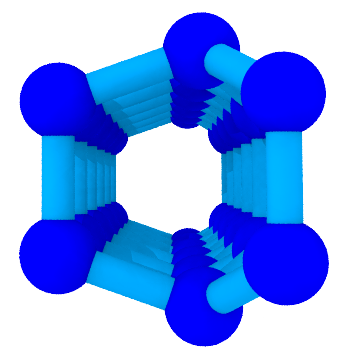
CHILL+ versus cages
Two classifiers live in libyodaLib. They answer different questions
and they do not imply each other.
Four-neighbour star
CHILL (seams chill, chill::getCorrel / getIceTypeNoPrint) and
CHILL+ (seams chill-plus, chill::getCorrelPlus /
getIceTypePlusNoPrint) look at the four-neighbour star. Both stay
on the host. They compute bond-order correlations c_ij on the four
nearest neighbours of each oxygen (or each mW site) and label the
atom cubic, hexagonal, interfacial, clathrate, or water from the
staggered and eclipsed pattern of that star.
A molecule is cubic or hexagonal when its four bonds look like ice, even if those neighbours do not close a cage.
CHILL+: Nguyen and Molinero, J. Phys. Chem. B 2015 (10.1021/jp510289t). CHILL: Moore et al., Phys. Chem. Chem. Phys. 2010.
Cage membership
The ice score (seams cages, ring::seededCageAffiliation by
default) is cage membership. A molecule in a hexagonal cage (HC) is
ice Ih. A molecule in a double-diamond cage (DDC) is ice Ic. A
molecule in neither is water. The cages are assembled from
six-membered primitive rings on a chosen bond graph, not from the
four-neighbour star.
This is topological unit matching (TUM). The methods paper is the 2020 JCIM article (see Citation).
The GPU path (gpu::analyzeResident) is that TUM ice score only:
linkcell::gpu k-nearest, the mutual four-nearest graph, primitive
six-rings, and HC/DDC affiliation. CHILL, CHILL+, and \(q_{lm}\)
stay on the host. Only cage labels come back.
Why they disagree
A configuration can agree exactly on the closed star of a vertex (same induced graph, same coordinates on those five atoms) and still disagree on that vertex’s cage label, because the cage predicates read a larger neighbourhood of six-rings. The Catch2 suite encodes that fact: cage membership is not a function of the four-neighbour star.
On the in-tree mixed TIP4P dump
(input/traj/exampleTraj.lammpstrj), CHILL+ reports 12 interfacial
clathrate and 238 water. Seeded cages report zero HC and zero DDC.
A three-eclipsed star is not cage membership. Walk through the
commands in the mixed TIP4P tutorial.
Bond graph
seams cages --graph chooses the bond graph those rings are found
on:
value |
graph |
|---|---|
|
pairs inside the distance cutoff |
|
mutual k-nearest (default |
|
union k-nearest (completion graph of the seeded rule) |
|
mutual seeds, union completions (CLI default) |
On a perfect cubic crystal the four graphs coincide. On a mixed nucleation dump they do not have to.
Ring-adjacent completion
ring::seededCageAffiliation takes a fifth argument,
ringAdjacentCompletion, default false. When the flag is true,
the accepted labels pass through ring::ringAdjacentCompletion: a
permissive six-ring with all but one vertex labelled fills that last
vertex, iterated to a fixed point. Hexagonal cage (HC) flags and
double-diamond cage (DDC) flags run as two walks.
seams cages --complete sets the flag. The rule, the least-fixed-point
claim, and the Lean build live on
Ring-adjacent completion.