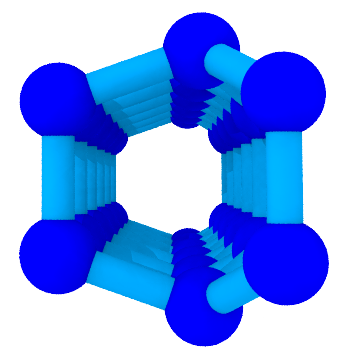
Sheared cells
You have a triclinic LAMMPS dump and want the engine to use the real cell, not a diagonal of bound spans.
A dump ITEM: BOX BOUNDS line is lo hi [tilt]. The reader stores
hi - lo per axis in PointCloud.box[0..2] and, when a third
number is present, appends xy, xz, yz so box.size() >= 6.
Those first three numbers are bound spans. They are not the
lattice edge lengths.
The engine recovers the restricted-triclinic matrix H (rows
\(\mathbf{a}\), \(\mathbf{b}\), \(\mathbf{c}\)) and the origin from
the spans, the tilt, and boxLow. Neighbour lists and every
minimum-image distance use that H. Wrapping each Cartesian axis
by box[0], box[1], box[2] is the wrong image on a sheared
cell.
The seams CLI has no tilt flag. A sheared dump is enough.
seams read prints the three bound spans and, when
box.size() >= 6, xy xz yz. seams rdf histograms
rdf::partialRdf with the same dump MIC; the ideal-gas volume is
nneigh::dumpVolume (|det H|, not the product of bound spans).
seams density-z takes \(A_\perp\) from that H (ly*lz for x,
and so on), not from bound spans.
Type selection on a mixed dump is --type I; unlike-pair RDF is
--types I,J. See Ionic-liquid dumps.
The dump layout is on data
formats.
Recover H
nneigh::dumpBoundsToH (and lammpsBoxToLcCell /
lammpsBoxToLinkcell) invert the LAMMPS bound mapping:
lx = xspan - max(0, xy, xz, xy+xz) + min(0, xy, xz, xy+xz)ly = yspan - max(0, yz) + min(0, yz)lz = zspanorigin is
boxLowminus the same lower clip
gen::periodicDistSq / gen::relDist call
gen::triclinicMinImage when box.size() >= 6: fractional
coordinates relative to that origin, wrap the fractional
difference, map back through H. A length-3 box stays an
independent-axis wrap of the three spans.
Catch2: LAMMPS dump bounds convert to lattice H, relDist mixed image disagrees with span wrap, relDistFromPoint uses dump H on a mixed image, formatDumpBox prints tilt when box.size() is 6.
Neighbour lists
Cutoff lists (nneigh::neighListO, neighList, halfNeighList,
getNewNeighbourListByIndex, the vesin cell list, the brute
fallback, and SkinNeighborList) pass the dump 3x3 into the
minimum image. k-nearest lists (kNearestNeighbourList) build
the same H through lammpsBoxToLinkcell. Device ice-score
batches use residentFrameCell: nBox >= 6 or a supplied
boxLow becomes one dump cell; three lengths stay ortho.
A pair that is only close across the a image of a sheared cell
is a neighbour at cutoff 1.0. Treating the bound span 15 as lx
misses that pair.
Catch2: tilt dump cutoff list finds the a-image pair, sheared box k-nearest uses the periodic image, residentFrameCell uses dump H when nBox is 6, residentFrameCell stays ortho for three lengths.
Other MIC users
The same dump H feeds Steinhardt flattening, hydrogen-bond distances, cluster unwrap, and the in-plane RDF sampler.
Catch2: steinhardtQl flatten uses dump H not span minImage,
getHbondDistanceOH uses dump H on a mixed image,
populateHbondsWithInputClouds accepts a mixed-image dump-H bond, populateHbondsFromDonors on that same sheared OH,
recenterClusterCloud unwraps a mixed image on dump H,
recenterClusterCloud unwraps a three-atom mixed-image chain,
sampleRDF_AA histograms the tilt a-image pair.
seams rdf FILE --cutoff RMAX is the 3D partial \(g_{IJ}(r)\).
Catch2: dumpVolume uses det H not bound spans, partial RDF first bin sees the sheared a-image pair, partial RDF like-type does not count the unlike neighbour, runningCN at rmax is one for a single I-J pair, firstMinimumBin finds the valley after the first peak. The in-plane sampler remains
rdf2::sampleRDF_AA on a PointCloud. rdf::runningCN and
rdf::coordinationNumber integrate 4 pi rho_J s^2 g ds with
rho_J = nJ / volume; the cutoff is a caller input, not a
hard-wired first minimum.
Empty or ortho clouds
box.size() < 3 yields an empty neighbour list. A length-3 box
is treated as ortho. XYZ files in this tree do not carry a
periodic cell; use a LAMMPS dump when the true H matters.