Data Formats
seams and the C++ readers share one suffix table. Coordinates are
Cartesian Angstroms. Frames are 1-based (the file’s timestep value is
not the frame index).
suffix |
reader |
always compiled? |
|---|---|---|
|
LAMMPS dump text |
yes |
|
|
yes |
|
|
only with |
|
|
only with |
The CLI matches the substring after the last . (xyz, con,
pdb, gro, dcd). Everything else, including a path with no
dot, is a LAMMPS dump. seams --features reports chemfiles and
readcon-core. Python pydseams.read and Lua dseams.read use the
same suffixes.
Type columns
reader |
|
|
|
|---|---|---|---|
LAMMPS |
|
single-frame: keep type 2, then type 1 if empty |
keep type |
XYZ |
hard-coded |
ignored on the read |
ignored on the read |
chemfiles |
numeric |
keep every atom ( |
keep type |
readcon |
atomic number from the file |
keep every atom |
keep every atom ( |
Point::atomID is the file id when the format has one, else
1-based file order. Point::molID is mol when present, else
atomID (chemfiles: residue id when the format has residues).
Empty frames
A reader that cannot fill atoms returns a cloud with nop == 0
(pts empty). currentFrame is still the requested 1-based index
when the reader knows it.
situation |
result |
|---|---|
LAMMPS path missing or unreadable |
empty cloud, |
LAMMPS frame does not exist |
empty cloud, |
LAMMPS type filter matches nothing |
|
XYZ path missing |
|
chemfiles frame out of range |
cloud left as passed in (usually empty) |
chemfiles throws |
empty cloud |
readcon path unreadable or frame missing |
empty cloud |
seams chill / seams chill-plus on an empty cloud print nop 0
and return 0. seams cages prints nop 0 graph KIND hexagonal 0 cubic 0 water 0.
sinp::nLammpsFrames is 0 when the file cannot be read.
sinp::forEachLammpsFrame is a no-op when that count is 0, or
when first > last. The CLI’s range dispatcher treats XYZ as one frame
and reads chemfiles/readcon frames serially; it preserves requested frame
order for every supported suffix.
LAMMPS dump
Default reader. Text dump, frames concatenated, each starting with
ITEM: TIMESTEP.
ITEM: TIMESTEP
15000000
ITEM: NUMBER OF ATOMS
750
ITEM: BOX BOUNDS pp pp pp
-2.0000000000000000e+01 2.0000000000000000e+01
-2.0000000000000000e+01 2.0000000000000000e+01
7.0316731227034523e+00 1.8723432986906221e+02
ITEM: ATOMS id mol type x y z c_peratom
1 1 2 1.62441 -0.745636 131.621 -28.449
2 1 1 2.11159 -0.763153 132.444 9.60885
That block is the first snapshot of
input/traj/exampleTraj.lammpstrj (750 atoms, 250 waters).
Required ITEM: ATOMS columns: type, and one coordinate triple.
The coordinate names follow LAMMPS ReaderNative: x / y / z
if present, otherwise the first of xu / xs / xsu (and the y
and z analogues yu / ys / ysu, zu / zs / zsu). Extra
columns are ignored.
Optional columns: id, mol. Missing mol falls back to id.
If both are missing, the reader uses column 0 for both.
PointCloud.box is hi - lo per axis (the LAMMPS bound spans, not
the lattice edge lengths). PointCloud.boxLow is the lower bound.
A third number on a box line is a triclinic tilt (xy, then xz,
then yz) and is appended to box. When those three tilts are
present, box.size() >= 6. Pair distances go through
gen::periodicDistSq / gen::triclinicMinImage, which recover H
with the same mapping as nneigh::dumpBoundsToH /
nneigh::lammpsBoxToLcCell. An independent-axis wrap on the bound
spans is the wrong image for a sheared cell; see
Sheared cells.
gen::formatDumpBox prints the spans and, when present, the tilt.
Dump writers emit ITEM: BOX BOUNDS xy xz yz pp pp pp and a third
field on each bound line when the cloud carries tilt.
seams read prints the three bound spans (box Lx Ly Lz) and,
when box.size() >= 6, the tilt (xy xz yz).
Mixed water dumps in this tree use type 2 for oxygen and type 1 for hydrogen. Single-site mW dumps in this tree use type 1.
A two-type (or multi-type) dump is the same text format. Each atom
keeps its ITEM: ATOMS type value. seams read / chill /
cages still filter through --type (readLammpsTrjO). seams rdf --types I,J with I != J loads every atom (readLammpsTrj)
and histograms I-J pairs. The pair list is
nneigh::neighListPair; the histogram is rdf::partialRdf.
Neither is an ice score. A mixed-type
dump that is not that water convention (ionic liquid, solvent plus
solute) needs an explicit --type I; the default 0 guess is type
2 then type 1. The C++ filter is sinp::readLammpsTrjO or
gen::getPointCloudOneAtomType. See
Ionic-liquid dumps.
A live dump session caches ITEM: TIMESTEP offsets. Sequential
walks do not rescan prior snapshots. seams --frame N --last M --jobs J walks that table with one handle per OpenMP worker.
sinp::dropLammpsDumpIndex drops a cached session (tests that
rewrite a path in place).
The two type-filtered C++ readers take the same slice arguments
(isSlice, coordLow, coordHigh) and do not keep the same atoms.
reader |
keep |
|---|---|
|
Every atom of the requested type. |
|
Atoms of the requested type that pass the slice, or every atom of that type when |
An axis is inside the box when the coordinate lies in the closed
interval, or when that axis has lo == hi (unconstrained).
([0,0,0], [50,0,0]) is x in [0, 50], y and z open.
The CLI does not expose the slice. Python
Frame(..., region=(lo, hi)) calls readLammpsTrjreduced. Lua
dseams.read calls readLammpsTrjO and has no region; a shrinking
read is dseams.core.readLammpsTrjreduced.
XYZ
Always compiled. Standard XYZ:
12
comment
O 8.995 10.3859997 15.0939999
O 6.7459998 14.2810001 15.0939999
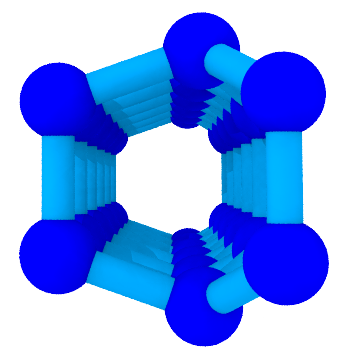
templates/hc.xyz is this shape (hexagonal-cage template). The first
line is the atom count, the second line is skipped, each data line is
symbol x y z. Every atom is stored as type 1. The box is the axis-
aligned bounding box of the coordinates (boxLow is the minimum);
the comment line is not parsed for a lattice. seams routes .xyz
here and ignores --type on the read (classification still uses
--type, which then sees type 1).
XYZ files in this tree do not carry a periodic cell. Analyses that need the true box should use a LAMMPS dump.
chemfiles (PDB, GRO, DCD)
Compiled when Meson finds chemfiles (SEAMS_HAS_CHEMFILES). The CLI
opens .pdb, .gro, and .dcd only. The C++ entry
sinp::readChemfiles accepts any path chemfiles can open.
Frame N is read_step(N-1). --type I with I > 0 keeps that
numeric type; otherwise every atom is kept. Type is the chemfiles
type or name string when it is all digits, otherwise the atomic
number (value_or(1)). box is the cell lengths; boxLow is the
origin. atomID is the 1-based file order. molID is the residue
id when the format has residues, else atomID.
A flake build leaves chemfiles off. The default pixi environment
ships chemfiles, so pixi run build reports chemfiles: enabled.
eOn .con
Compiled when Meson finds readcon-core (SEAMS_HAS_READCON).
input/con/tiny_multi_cuh2.con is a two-frame fixture (Cu + H,
con_spec_version 2).
type is the atomic number from the file. atomID is the file atom
id. molID is set to atomID. box is frame->cell[0..2];
boxLow is the origin. Frame N is the Nth record from the
iterator. The CLI does not type-filter .con.
A flake build leaves readcon-core off (the wrap is not downloaded).
Enable it in a Meson build that can see the wrap or a system package,
then seams --features reports readcon-core: enabled.