Stacking disorder
Cubic ice and hexagonal ice are the same puckered hexagons stacked in two orders. Hexagonal ice repeats every two layers. Cubic ice repeats every three, and the next layer sits over the hole of the one before. A stacking fault is one layer in the other order. Both crystals, and the fault between them, have a high local \(q_6\). A cutoff on \(q_6\) therefore reports “ice” and stops.
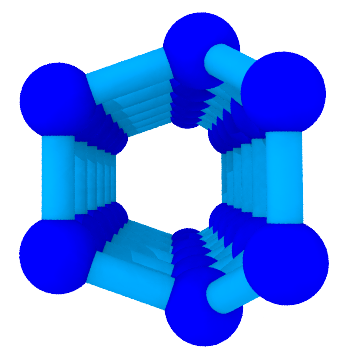
The ring and cage census names the order. A hexagonal layer is a
six-ring that is the base of a hexagonal cage: two basal faces and
three prismatic faces. A cubic layer is a six-ring that closes a
double-diamond cage, seven six-rings around one chair. A molecule that
belongs to both cages sits on the fault. CHILL+ writes that as
both, and writes the rest of each layer as hexagonal or cubic.
None of those names is a threshold on \(q_6\).
The interface frame in
the interface tutorial is the
small case. Its stack string is HHHHHHHH....C.: eight hexagonal
slabs and one cubic layer. Of 864 molecules, 352 are hexagonal and 1
is cubic. A \(q_6\) cutoff would add those together. The cage search
keeps them apart, which is what a growth rate on the basal face needs:
the front advances by adding a layer of one polytype, and the fault
is a layer, not a drop in \(q_6\).
The same split is why the nucleation frames report cubic and hexagonal counts separately. The largest crystal cluster can contain both, and the fraction of each says which polytype the nucleus is growing. \(q_6\) on that cluster is one number.