Classify a clathrate
GenIce builds the three clathrate ices without guests. The cage search
is the signature census: closed polyhedra whose faces match a ring-size
list. meson test docs_tutorial_clathrate runs that search and checks
the counts.
The cells are already in the tree, each well under a megabyte.
cell |
file |
molecules |
census |
|---|---|---|---|
sI |
|
46 |
2 of \(5^{12}\), 6 of \(5^{12}6^{2}\) |
sII |
|
136 |
16 of \(5^{12}\), 8 of \(5^{12}6^{4}\) |
sH |
|
136 |
four unit cells, so 12, 8 and 4 |
The sH unit cell is 3 of \(5^{12}\), 2 of \(4^{3}5^{6}6^{3}\), and 1 of \(5^{12}6^{8}\). The file is that cell repeated four times, and the test checks \(12, 8, 4 = 4 \times (3, 2, 1)\).
sH is a skewed cell. The default cage-edge window measures bond lengths
as if the box were orthorhombic, and the long faces then fall outside
it. --cage-edge none keeps every primitive ring. sI and sII are
orthogonal, and the default window leaves their census unchanged.
seams cages input/traj/genice_sI.lammpstrj --type 1 --graph cutoff --signature 512+51262
seams cages input/traj/genice_sII.lammpstrj --type 1 --graph cutoff --signature 512+51264
seams cages input/traj/genice_sH.lammpstrj --type 1 --graph cutoff \
  --cage-edge none --signature 512+sh+51268
The lines you should see are cages 2 and cages 6 on sI, cages 16
and cages 8 on sII, and cages 12, cages 8 and cages 4 on sH.
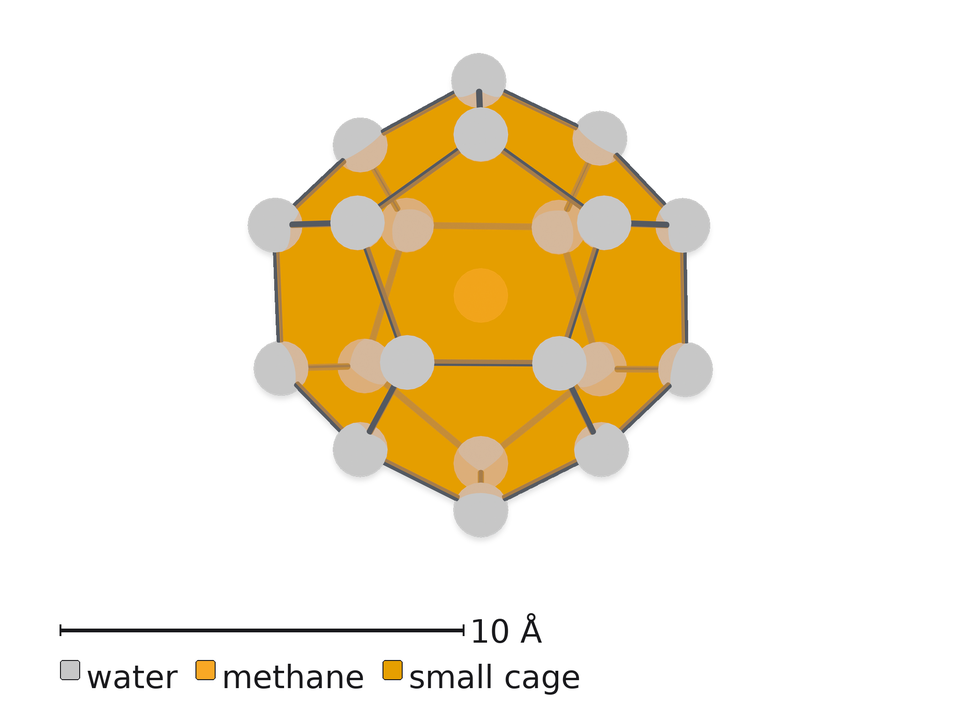
GenIce sI host. sII and sH are drawn the same way. python docs/scripts/render_molecules.py --slug cage-si writes the 2400 by 1800 still.