CHILL+ on an ice/water slab
An interface is where a rule is easy to fool. The crystal half should be hexagonal ice. The liquid half should be water. The molecules in between are the ones where the published CHILL+ rule and the OVITO rule can part company, because they do not use the same neighbour test.
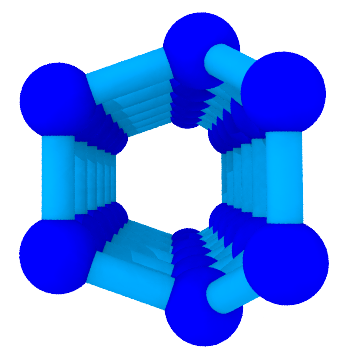
The page builds that slab instead of reading a dump from the tree. GenIce supplies a 2 by 2 by 1 ice Ih cell, oxygen only, so the hydrogen disorder is not part of the label. A copy of that cell is shifted by one box length along z and shaken by less than an angstrom. The shake is why the upper half is liquid: the oxygens are no longer on lattice sites. OpenMM then minimises the stack for eight steps with the lower half restrained. The restraint is why the crystal survives the relax. The cutoff is 3.5 Å, the same shell CHILL+ will read, and it has to sit under half the shortest box edge or OpenMM refuses the periodic force.
meson test docs_paper_interface runs this and checks the two lines.
The published rule prints
interface published hexagonal 68 interfacial 19 water 41
The OVITO rule prints
interface ovito hexagonal 68 interfacial 20 water 40
Both rules call 68 of the 128 oxygens hexagonal. They move one molecule
between interfacial and water. That single molecule is the reason to
name the rule when you quote an interface count. The layer stack is
HHHHH: five crystal slabs and no cubic ice, so \(\phi_c\) is 0.
OVITO draws the same oxygens, so you can see the slab the numbers
came from. The test exits 77 when GenIce, OpenMM, or OVITO is absent.
Full run
The paper frame in this tree is input/traj/interface_f0.lammpstrj:
864 molecules, one frame. meson test --suite slow docs_paper_interface_full reads that file. It prints the molecule
count, the frame count, and the path, then the published and OVITO
censuses.
interface full input molecules 864 frames 1 file-frames 1 file input/traj/interface_f0.lammpstrj
interface full paper molecules 864 frames 1
interface full published hexagonal 352 interfacial 49 water 434 clathrate 3 interClathrate 25
interface full ovito hexagonal 346 interfacial 57 water 437 clathrate 3 interClathrate 20
interface full phi-c 0.00283286
interface full stack HHHHHHHH....C.
The stack is eight hexagonal slabs, a gap, and one cubic layer. Hexagonal is 352 on the published rule and 346 on the OVITO rule. The test exits 77 when OVITO or Snakemake is absent.