Primitive rings and the shortest-path test
A ring search first walks every simple cycle up to a chosen size.
Many of those cycles are not useful: a chord gives a shorter route
between two vertices, so the long way around is not a ring of the
network. The Franzblau test keeps a cycle only when, for every pair
of its vertices, some shortest path between them lies on the cycle.
Those survivors are the primitive rings. seams rings reports that
census. The tutorial also counts the cycles before the test, so you
can see what the filter removes.
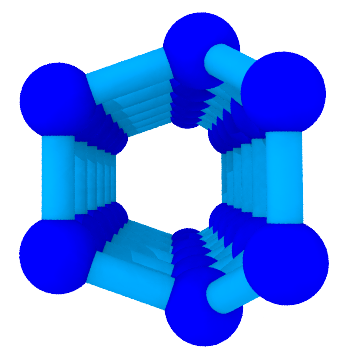
The cell is GenIce ice Ih, one unit, 16 oxygens, cutoff 3.5 Å. It is small on purpose. Every cycle of length 4, 5 or 6 can be listed, and the same neighbour list is what the primitive search uses. A larger crystal would hide the filter, because almost every six-cycle in ice Ih already passes.
meson test docs_paper_rings checks
rings primitive 4 24 6 32
rings shortest 4 24 6 32
rings searched 4 24 6 128
The shortest-path test and seams rings agree: 24 four-rings and 32
six-rings. The unfiltered search found 128 six-cycles. The other 96
have a shortcut, so they are dropped. There is no five-ring. OVITO
draws the 16 oxygens. The test exits 77 when GenIce or OVITO is absent.
Full run
The paper’s ring census is one frame of
input/traj/mW_cubic.lammpstrj. The dump holds 11 frames of 4096
molecules. The test reads frame 1. The paper states 4096 molecules
and 8192 six-rings.
meson test --suite slow docs_paper_rings_full checks
rings full input molecules 4096 frames 1 file-frames 11 file input/traj/mW_cubic.lammpstrj
rings full paper molecules 4096 frames 1 rings 8192
rings full nop 4096 rings 8192
rings full histogram 6 8192
The histogram has one bin: 8192 six-rings. OVITO draws that frame. The test exits 77 when OVITO or Snakemake is absent.